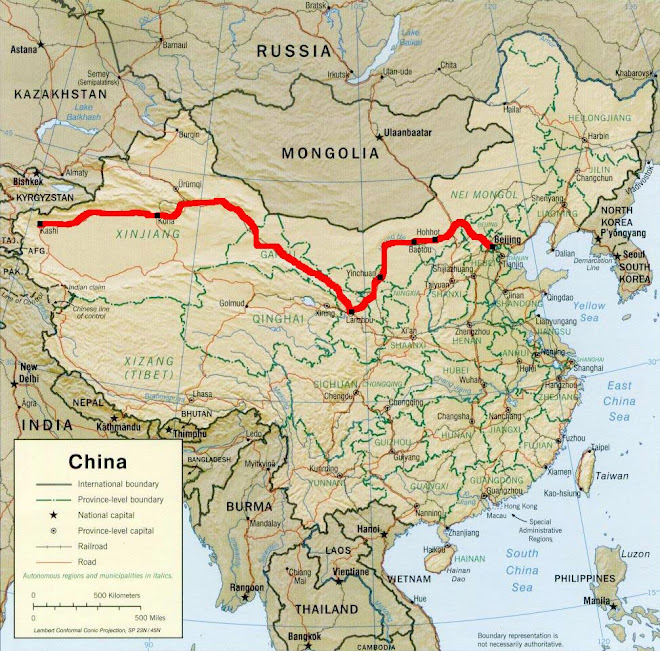
Well, as far as I can see Inner Monglia consists of the steppe, some stunning scenery and road works.
We set off from Datong after our day off feeling pretty fresh. I had actually already begun to miss sitting on the bike and seeing white centre lines rushing (or crawling) past me. To be honest so much has happened since then it's hard to remember even s far back as a few days. One thing that is impossible to forget though is the road we took out of Datong and in to Inner Mongolia. It was, quite simply, stunning. It wound itself precariously through some of the most stunning natural and man made scenery I have ever seen. Rolling hills and craggy peaks, dotted around with some of the oldest pieces of the Great Wall still in existence. Needless to say, Pryd and I got very, very excited. We were giggling like schoolboys who had not only been given double maths off because their teacher was ill, but at the same time found out that not only was the teacher ill, he had Gonorrhea.
Hohot itself, however, was a fairly unremarkable town. We stayed the night and left early the next morning.
The next day was characterised by soaring highs and crashing lows. Highs brought about the scenery, which was still breathtaking. The Mongolian grasslands at this time of year truly are a fantastic sight. Lows were brought about by road works, tons of roadworks. Sand, mud, gravel, stones, sand, mud on gravel, and sand. It really was very tough going and we made painfully slow progress. As has been pointed out to me, we may have felt like Genghis Kahn but we probably made slower progress than he did across Inner Mongolia that day. The denouement of this odyssey of road works was a puddle of muddy water about a foot deep under a bridge. We emerged with bikes and gear covered in mud. Our beautiful chrome finish which glinted so stylishly in the sun was well and truly gone.
These trials and tribulations were more than made up for, however, by the place we decided tp camp for the night. The middle of the Mongolian grasslands is a great place to pitch camp. Even the fact that I couldn't stand up to put my trousers on in the morning did not detract from it. A truly memorable night.
The rest of our time in Inner Mongolia has consisted of more road works and some incredibly heavy industry. The whole of Inner Mongolia after where we camped was grey from smog and dust. The problem in Inner Mongolia is that it is never meant to have been farmed, it is meant to be pasture, as it has been for thousands of years. Now, however, it is being farmed by sedantry Han Chinese which means that the thin topsoil, ater it has been cultivated for a few seasons and exhausted of its nutrients, is simply left to blow away. When this is added to the severe pollution in some areas the whole place is cloaked in a concrete grey smog which rarely lifts. It is a tragedy, as Inner Mongolia has the potential to be one of the world's truly beautiful places.
So, as it happens, we were quite happy to be out of Inner Mongolia, as I write this we are in Yingchuan, capital of Ningxia province, and will hopefully make it into Gansu province tomorrow.
Showing posts with label motorbike. Show all posts
Showing posts with label motorbike. Show all posts
Wednesday, July 22, 2009

Sunday, June 14, 2009
The Charity
China's growth over the past thirty years is quite simply unprecedented in history. Since the era of "reform and opening up", ushered in by Deng Xiaoping in 1978, China has grown by an average of 9.5% year on year. China is now, in GDP terms, the world's third largest economy, behind only the United States and Japan. Given China's current rate of growth, it is posed to overtake the U.S.A in less than twenty years.
So, then, why on Earth would a Chinese educational charity need our money? The fact is that, although China has experienced astronomical growth over the last forty years, raw GDP figures do not tell the whole story, especially given China's enormous population. According to the International Monetary Fund China's per capita GDP in 2008 was still only $3,315, placing it only one place above Iraq and two places above the Republic of Congo.
If one also takes into account the fact that the vast majority of China's rapid growth has taken place along its far Eastern coastline, concentrated around the cities of Beijing, Shanghai and Shenzhen, then one can clearly appreciate that China's interior is still unimagineably poor. There are, therefore, more than 354 million Chinese still earning less than $2 a day, 120 million of which earn less than a $1 a day.
It is true that the Chinese government has taken some limited steps to iron out this vast, and growing, inequality gap. However, it has had little effect. In 2004 China's Gini coefficient (a measure of equality whereby complete equality is measured at 0) stood at 46.9. Putting it on a par with Rwanda, and considerably less equal than Japan at 24.85.
On top of all this, the rural poor in China are also denied many basic rights that those in the cities enjoy. There is no free education and no free healthcare. China's all-pervasive 'hukou' system of household registration also means that the rural poor are prohibited from seeking a better life in the more developed cities. As a result China's rural poor are locked into a cycle of poverty which is harder to break than in many other develping countries.
In this context, therefore, charities that assist in the education of children in these poorer areas are extremely valuable. The charity we are supporting is attached to Peking University and runs two basic services. The first is sponsoring children through school, paying for their tuition fees and basic learning materials. The other is helping to found libraries in schools, thereby providing the whole school with crucial learning materials to which the children otherwise would not have access.
It costs around £500 to found a library at a school, and we would very much like to fund at least a couple. Therefore any donations that you feel you could make to this worthy cause would be very much appreciated. As an added incentive, whichever individual or organisation donates the most money they will get the naming rights to one of the libraries. Donations can be made via our fundraising website:
http://www.charitygiving.co.uk/thruthemiddle
Thank you so much for your support, it really is appreciated!
So, then, why on Earth would a Chinese educational charity need our money? The fact is that, although China has experienced astronomical growth over the last forty years, raw GDP figures do not tell the whole story, especially given China's enormous population. According to the International Monetary Fund China's per capita GDP in 2008 was still only $3,315, placing it only one place above Iraq and two places above the Republic of Congo.
If one also takes into account the fact that the vast majority of China's rapid growth has taken place along its far Eastern coastline, concentrated around the cities of Beijing, Shanghai and Shenzhen, then one can clearly appreciate that China's interior is still unimagineably poor. There are, therefore, more than 354 million Chinese still earning less than $2 a day, 120 million of which earn less than a $1 a day.
It is true that the Chinese government has taken some limited steps to iron out this vast, and growing, inequality gap. However, it has had little effect. In 2004 China's Gini coefficient (a measure of equality whereby complete equality is measured at 0) stood at 46.9. Putting it on a par with Rwanda, and considerably less equal than Japan at 24.85.
On top of all this, the rural poor in China are also denied many basic rights that those in the cities enjoy. There is no free education and no free healthcare. China's all-pervasive 'hukou' system of household registration also means that the rural poor are prohibited from seeking a better life in the more developed cities. As a result China's rural poor are locked into a cycle of poverty which is harder to break than in many other develping countries.
In this context, therefore, charities that assist in the education of children in these poorer areas are extremely valuable. The charity we are supporting is attached to Peking University and runs two basic services. The first is sponsoring children through school, paying for their tuition fees and basic learning materials. The other is helping to found libraries in schools, thereby providing the whole school with crucial learning materials to which the children otherwise would not have access.
It costs around £500 to found a library at a school, and we would very much like to fund at least a couple. Therefore any donations that you feel you could make to this worthy cause would be very much appreciated. As an added incentive, whichever individual or organisation donates the most money they will get the naming rights to one of the libraries. Donations can be made via our fundraising website:
http://www.charitygiving.co.uk/thruthemiddle
Thank you so much for your support, it really is appreciated!
Subscribe to:
Posts (Atom)